Most Meta Ads Problems
Aren't Campaign Problems.
Ownership, pixels, server events, verification — the foundation underneath every campaign. No amount of creative testing fixes a Meta account nobody's checked. This is the Meta side of the Ecosystem Audit: 12 components, checked individually, before anyone touches a campaign.
12 Components. Nothing Assumed.
Every component below gets checked individually — not inferred from ad performance. The Meta side leans hard on one question in particular: who actually owns each asset — the business's own Business Portfolio, an agency's, or somebody's personal account. Applicability flexes per business: an e-commerce store gets Catalog / Commerce graded; a lead-gen business gets Lead / Instant Forms instead. Components that don't apply are marked N/A, not skipped silently.
Business Portfolio
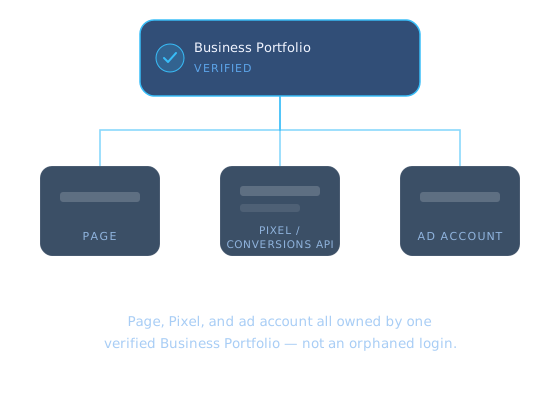
The top-level container holding your ad accounts, Pages, pixel, and people. Everything else in the Meta ecosystem lives inside one.
- Owned by the business, not sitting in an agency's or a personal account
- Business verified with Meta, not stuck in a pending state
- No orphaned admins who no longer work with the business
People & Partners
Who has access to the Business Portfolio, and at what permission level.
- Admin access sits with someone still at the business, not a departed employee or past agency
- Partner access scoped to what's actually needed, not full admin
- No duplicate or unused access grants left open
Facebook Page
The business's Page identity — the thing ads actually run "from."
- Owned by the business's Business Portfolio, not a personal profile
- Admin roles match who's actually running things today
- Page info — hours, category, contact — accurate and current
The connected Instagram professional account ads and organic content run through.
- Connected to the correct Business Portfolio and Page, not a personal account
- Login and 2FA not tied to one person who could lock everyone out
- Linked correctly so ads can actually pull from it
Ad Account
The account itself — campaigns, budgets, and billing.
- Owned by the client's Business Portfolio, not an agency's
- Billing method current, not about to fail
- Account not sitting under a spend limit or restriction nobody noticed
Pixel / Dataset
The tracking pixel — now often called a dataset — that records what happens on your website.
- Actually firing — dead pixels are common and often go unnoticed for months
- Owned by the business, not orphaned in an old agency's portfolio
- Standard events (Purchase, Lead, etc.) firing, not just PageView
Conversions API
Server-side event sending that complements — or replaces — what the browser pixel alone can see.
- Actually sending events, not just "installed" with a system user that's never fired one
- Events match what the pixel reports, not duplicating or conflicting
- Deduplication configured correctly between pixel and server events
Domain Verification + AEM
Verifying domain ownership with Meta, and configuring Aggregated Event Measurement — which governs how conversions get prioritized post-iOS14.
- Domain actually verified, not sitting unclaimed
- Event priority order set to match what the business actually wants optimized
- Verification owned by the business's Business Portfolio, not a past agency's
Audiences
Custom, lookalike, and saved audiences built for targeting.
- Source audiences still refreshing, not frozen from months ago
- No audiences built on the wrong pixel or a stale customer list
- Overlap between audiences checked, not silently competing for the same people
Business Suite / Security
Two-factor authentication, admin access, and the account-security settings around the whole portfolio.
- Two-factor authentication enabled on admin accounts
- No unrecognized admins or lingering login access
- Recovery contact info current, not pointing at someone no longer involved
Catalog / Commerce
The product catalog that powers dynamic ads and commerce features.
- Connected to the correct pixel / dataset for dynamic ads
- Product data — price, availability, images — matches what's live on the site
- Feed status healthy, not sitting on disapproved items
Lead / Instant Forms
Native lead-generation forms that capture leads without leaving Meta's apps.
- Leads actually routing somewhere — a CRM, email, or download — not sitting unclaimed
- Form fields match what the sales process actually needs
- Ownership of the form and page sits with the business
Ownership. Owner. Active. Then A Finding.
Every applicable component gets the same treatment: what kind of ownership it has, who actually holds it — the business's own Business Portfolio, an agency's, or a personal account — whether it's active, a written finding when something's off, and its linked assets mapped. Not a checklist — a graded board, the same format used across the full Ecosystem Audit.
Findings from a real audited account — identifying details removed. See the full scored boards on the Ecosystem Audit page.
Same Framework. Different Weight.
E-Commerce
Catalog / Commerce and Conversions API carry the most weight — dynamic ads live or die on feed health, and server-side events aren't optional anymore.
Local Service
Facebook Page and Business Suite / Security matter most — a trustworthy, uncompromised Page outweighs audience sophistication.
Lead Gen
Lead / Instant Forms and Audiences carry the most weight — native forms only pay off if leads actually route somewhere, and audiences need real source data to build from.
Every applicable component gets graded either way — this just previews which parts of the framework usually carry the most weight for your business type.
See This Applied To Your Account.
This is the other half of the Ecosystem Audit. $997 covers both Google and Meta, end to end — every applicable component graded, a written finding for what's off, a prioritized fix list.